Courage - Common Sense - Country

Saturday, April 20, 2019

What were they thinking?

Image result for Political sellouts

On April 16, the Nevada Assembly passed Bill AB186 - an act directing Nevada Electoral College Electors to cast their votes for the candidate who won the national popular vote for President in the federal election. 

If passed by the Nevada Senate, Nevada would join the National Popular Vote Interstate Compact being pushed by National Popular Vote Inc., a California-based 501(c)(4) non-profit corporation.  To date, 15 States with 189 Electoral College votes have joined this compact.  They're virtually all red states (Hawaii, New Jersey, Illinois, Washington, Massachusetts, DC, Vermont, California, Rhode Island, New York, Connecticut, Colorado and New Mexico).  The compact is supposed to take effect when states with an aggregate of at least 270 Electoral College votes have approved the legislation.

The bill passed 23 to 17 with some senior Democrats voicing concerns.  I can see why!

In future federal elections, Nevada's presidential vote would be worthless, automatically tied to whichever candidate wins the big coastal states.  State Democrats on big on voter registration & turnout; this bill is a surefire way to depress voter participation.  Why bother voting when it won't have any influence on the state outcome and you can just as easily sit at home and watch TV?  This scheme will also lead to a loss of influence in Washington.  As a small state, the current Electoral College system gives us an over-sized advantage and voice in federal affairs.  Tie our vote to the national popular vote and we become real fly-over country.  Federal candidates will spend their time, money and efforts in the larger states, knowing that with a scheme like this in place, the herd will follow.  And they sure won't be inclined to listen to us in the off season.

What is most depressing about this is that Nevada politicians would sell our birthright in order to cozy up to national party bigwigs who are choked about losing to Donald Trump.  Sore losers try to change the rules instead of playing a better game.  If this legislation gets through the Senate we will become a political suburb of California. 

State legislators owe their first duty to their state and their constituents.  The Assembly's sold us out.

-- Mike Power


Saturday, April 13, 2019

The border crisis and political football

By all objective measures, there is a serious problem developing at the US - Mexico border.  A recent article by the New York Times lays out the current scope of the problem.

Currently over 100,000 people a month are jumping the southern border.  Unlike earlier migrations which were often from Mexico and driven by economic forces, the current wave of migrants are fleeing Central America and they are trying to escape mindless violence.  Governments in El Salvador, Honduras and Guatemala are unable to maintain law and order, allowing gangs to effectively take over portions of their countries.  Turf wars between rival gangs and vestigial government authorities are wreaking havoc.  Business Insider ranks El Salvador as the most dangerous country to visit in the world; Guatemala and Honduras rank 6th and 5th.  El Salvador and Honduras now have the highest and second highest murder rates of 230 countries monitored by the UN.  Is it any surprise we now have a crisis on the southern border?

The Time article states that over 1,000,000 migrants tried to jump the border in the year ending last September.  The numbers have swelled since then.  The U.S. immigration system is now swamped with a backlog of over 800,000 pending cases.  The average time to process each case: 700 days.  With no capacity to detain these migrants, they are being released - unceremoniously dumped at the nearest bus station or the edge of town by the authorities after being notified they will be contacted later about their immigration status. 

 Driven to fury by the problem and what is perceived as opportunistic obstruction by the Democratic House, the administration drove the past Secretary of Homeland Security, Kirstjen Nielsen to resign.  A California court recently poured fuel on the flames by denying the administration the right to force migrants to wait in Mexico pending resolution of their claims. As noted in The Week:
But things truly cross over into the absurd with the recent decision of a California judge to block the Trump administration's effort to get most migrants to remain in Mexico until their asylum hearing. The U.S. is confronting a flood of migrants fleeing oppression, violence, and poverty in one country (usually Honduras, Guatemala, or El Salvador), crossing a massive intermediary country (Mexico) that no one claims is persecuting them, and yet a judge insists that it's a violation of the law to deny them entry.  That ruling is either an outrageous warping of the law, in which case it needs to be quickly overturned by a higher court, or it is a demonstration that the law itself needs to be changed to allow U.S. policymakers to determine who and how many get admitted to the country, and when. In the current situation of years-long backlogs and restrictions on detaining kids, it amounts to a wide-open door to anyone who shows up on the border with a child claiming asylum. To the extent that current law requires this fiasco, it needs to be scrapped and replaced.
An exasperated President Trump responded by threatening to send detained migrants to self-declared "sanctuary cities" where local authorities have refused to cooperate with ICE.   Within the administration, there appears to be a ying-and-yang battle between Jared Kushner and Stephen Miller, his unofficial immigration czar.   There is no clear administration policy or plan beyond focusing on a hard line in dealing with the issue.

Until recently the Democrats have been sitting on the sidelines, condemning the measures taken by the administration but failing to propose any concrete program of their own.  In fact, as Politico reports, the Democrats appear to be seriously torn on the issue and unable to offer anything more than rhetoric and bills addressing peripheral issues such as the Dreamers. 


This might be changing.  It is interesting to note that 2020 Democratic Presidential front-runner Bernie Sanders recently opined on the issue of border security:
"If you open the borders, my God, there's a lot of poverty in this world, and you're going to have people from all over the world. And I don't think that's something that we can do at this point. Can't do it. So that is not my position.”
Whether Democrats like it or not, border security and immigration are going to be key issues in the next election with some pundits suggesting President Trump will make it a centerpiece campaign issue. Stand by for a battle royale on this issue with each side talking past each other to their bases.  Both parties have a part of the solution but with no willingness to cooperate to solve the problem, things may get a lot worse - especially for hundreds of thousands of migrants flooding into this country and the communities who have to receive and care for them.

Is there a solution?  Common sense suggests there is but it certainly won't be an easy one. The Alliance Party has laid out a pathway to reforming our immigration system:

As a nation of immigrants, we support legal immigration tied to the country’s economic needs and capacity to assimilate newcomers. We also support reasonable pathways to citizenship for those law-abiding persons in the country without legal residency status, and we support strong borders. We also believe in America’s unstinting moral obligation to help genuine asylum seekers. We affirm that part of the definition of self-government is the right of order to define who may and who may not become part of the nation.

This will likely involve:
  • Deploying additional financial resources, personnel, appropriate technology and infrastructure to secure the border.
  • Addressing the asylum crisis by changing legislation and regulations, and providing necessary personnel and resources, to quickly screen asylum applicants and assess their claims.  The right of asylum must be balanced with the duty of our government to control our borders for the general welfare of the country.
  • Recognizing that the current migrant crisis has roots far south of the border, America should, as a matter of high priority, work with Central American governments and community groups to re-establish peace, law and order in these troubled neighbors.  
  • Enacting legislation and regulations to provide a pathway to regularized immigration status and citizenship to law-abiding migrants who are already in the country.
  • Developing an immigration system that selectively admits immigrants who have the skills, aptitude and demonstrated motivation to quickly become self-supporting and contributing members of  American society.  There are excellent examples world-wide of immigration systems which have broad public support because they improve the general welfare of the receiving countries.     
It's time to stop playing political football with border and immigration issues.  We need to forge an approach that reasserts control over America's borders, treats all migrants decently and fairly, and welcomes immigrants who will make a contribution to our country.  

-- Mike Power


Saturday, March 23, 2019

Republicans against a return to the status quo


An interesting statement was recently signed by an influential group of Republican conservatives, fighting for the soul of the Republican Party.  They don't want a return to pre-Trump politics. Some of what they're advocating sounds very much like tenets of the Alliance Party.

An internal civil war broke out in the Republican Party when President Donald Trump effectively took it over during the 2016 campaign.  Many of the old guard are biding their time in the expectation the political landscape will return to normal when his term is up.  Others believe that the 2016 election was evidence of a real change in the political landscape.  The authors of the manifesto think this is the case and are advocating some radically un-Republican, centrist ideas:
 ... Our policy must accommodate the messy demands of authentic human attachments: family, faith, and the political community.
...In recent years, some have argued for immigration by saying that working-class Americans are less hard-working, less fertile, in some sense less worthy than potential immigrants. We oppose attempts to displace American citizens. Advancing the common good requires standing with, rather than abandoning, our countrymen. They are our fellow citizens, not interchangeable economic units. And as Americans we owe each other a distinct allegiance and must put each other first.
...We seek to revive the virtues of liberality and neighborliness that many people describe as “liberalism.” 


...We want a country that works for workers.

...The Republican Party has for too long held investors and “job creators” above workers and citizens, dismissing vast swaths of Americans as takers unworthy of its time. Trump’s victory, driven in part by his appeal to working-class voters, shows the potential of a political movement that heeds the cries of the working class as much as the demands of capital. Americans take more pride in their identity as workers than about their identity as consumers. Economic and welfare policy should prioritize work over consumption.

...We believe home matters..

...We embrace the new nationalism insofar as it stands against the utopian ideal of a borderless world that, in practice, leads to universal tyranny.
Their social values platform is naturally conservative but in many respects their economic and political ideas are definitely centrist.   

It seems that some people now appreciate that the real message of 2016 was that a large proportion of both Democratic and Republican voters are fed up with politics as usual.  They felt they had no voice and the result was a startling upset.  It could well happen again - in a way that might surprise both mainline parties.

-- Mike Power

THE ALLIANCE PARTY 

THE VOICE FOR REAL CHANGE 

Wednesday, March 20, 2019

Too much of a good thing.


I think we all can agree we need rigorous state regulation of  certain professions.  When the health, safety and vital welfare of the public are involved, there is a clear requirement that practioners be trained to do their work properly, have demonstrated they can do their work properly, and be monitored to ensure they do their work properly.  No one wants to see quack doctors, shyster lawyers, incompetent engineers or sloppy gas-fitters on the job.  

There is a continuum of occupational regulation however.  Common sense would suggest that work should only be regulated if necessary and only to the extent necessary to serve the public interest.   The range of options is shown below:


The recent trend has been towards licensing.  It seems to follow  a well worn path.  Some incident or series of mishaps occurs and the cause is traced to incompetent, negligent or wilful criminal behavior in a commercial transaction.  The public becomes alarmed and the cry goes up to "do something about this".  State politicians decide to "do something" which generally involves regulating the offender's occupation rather than diving into the nuts and bolts of specialized work.  In a sense, to fix the problem, they outsource it to those practicing the offending occupation and let them sort it out.  This is a good thing; I don't think we would want state politicians writing regulations on brain surgery.  

To minimize costs, the state largely turns regulation of occupations over to self-governing associations who set requirements, administer tests, license members and monitor compliance.  Self-regulation is set up to cost the state nothing - all expenses are borne by the association members.  Sometimes the state adds a surcharge to make regulation a net money maker.

Note that there is no push-back here.  Problem traced to some occupation comes up -> law gets passed empowering some occupational association -> occupational association hopefully takes care of the problem by regulating the profession.  The association has a vested interest in keeping out the bad apples to ensure the rest can make a living.

There are serious hidden costs to this system which the taxpayer does pay however.  Let's take a quick look at the symptoms of the problem:

Depending on the state, barbers, florists, auctioneers, court recorders, hair braiders, interior designers, landscapers, fortune tellers, cemetery plot salesmen, teaching assistants, bartenders, make-up artists, shampooers,... are all now regulated. 


In Nevada, the average occupational license for a lower-income occupation requires $704 in fees, more than two years of education and experience and two exams. These barriers to entry for aspiring workers restrict competition in licensed occupations, limiting economic opportunity and driving up costs for consumers. (Las Vegas Review Journal)
 What’s more, licensing requirements limit the mobility of skilled workers into a state. Why move if you’re going to have to take hundreds of hours of classes to get the license necessary to ply your trade? If someone has been a florist in a state where there’s no requirement for a license to sell flowers, why should he or she consider moving to a state where it could take months before getting the documentation necessary to peddle petunias again?
Kleiner and Krueger (2010 and 2013)show that after controlling for education, labor market experience, occupation, and other controls, licensing is associated with a 15 to 18 percent wage premium in the labor market. This estimate may partially reflect a premium for higher unmeasured human capital, but it is also consistent and likely in large part due to rents. 

The problem: collusion in restraint of trade


Adam Smith famously noted that:
 “People of the same trade seldom meet together, even for merriment and diversion, but the conversation ends in a conspiracy against the public, or in some contrivance to raise prices.”
Licensing can be used as a rent-seeking manoeuver to fence off occupations, preventing outsiders from gaining entry and maximizing profits for members.   In our litigious, risk-averse society, it is easy for well organized trade groups to convince vote hungry politicians that the public interest is served by licensing their occupations.   In the cause of public health, safety and general welfare, state politicians cooperate with trade organizations to create near monopolies on certain lines of work.  

How bad is it in Nevada?

It's bad.  Nevada now has the highest rate of occupational licensing in the nation.  The Mercatus Center at George Mason University has some choice words on the subject:  
The government of Nevada has developed extensive licensing requirements. In 2013, the latest year for which data are available, the state licensed 30.7 percent of the workforce and certified another 5.4 percent. According to Nevada’s Legislative Council Bureau, the state licenses “more than 50 professions, occupations, and businesses.” This would appear to undercount the number of regulated professions, however. A 2017 study by the Institute for Justice (IJ) examined occupational licensure laws for 102 lower-income occupations and found that Nevada requires a license for 75 of them. Only three other states—Louisiana, Washington, and California—license more low-income professions. The state also licenses such rarely licensed professions as interior designer, sign language interpreter, and animal trainer.
 Patterns in occupational licensing requirements contradict the idea that licensure is primarily used to protect public safety. Occupations that are less likely to involve risk to the public are often more highly controlled than riskier occupations. For example, Nevada’s emergency medical technicians (EMTs) must complete 26 days of training and pass two exams before being licensed to work on an ambulance team. By contrast, Nevada’s drywall installation contractors must complete 1,460 days of education and experience—56 times the amount of training required of EMTs.
There is significant variation in licensing requirements for the same jobs across states. Licensing boards can require a minimum level of education or experience, a steep processing fee, or a passing score on examinations. In Nevada, 53 of the 75 licenses identified by IJ require all three. All but one require the applicant to pay a fee, the highest of which is $2,250 for a travel guide license.

What can be done? 

Occupational licensing should be the last resort and not the first in regulating occupations to protect the public.  There should be clear, legislated criteria for licensing an occupation showing a direct and serious public risk; if you don't meet them, the request is refused.  Other means of regulating occupations should be employed where possible.  Standards should be harmonized with other states and comparable qualifications from other states recognized in Nevada.  Arizona recently led the way in this effort.

Fairness is at the heart of the American Dream.  When companies or trade groups use the law to restrict competition and capture profits in cooperation with pliant legislators, we all suffer - starting with those just looking for a job. 

-- Mike Power


Sunday, March 17, 2019

Fair business and the American Dream

A better America will be a fairer America - one that allows everyone to take their best shot in the "race of life".

It is becoming clear that there are some serious underlying problems with how we do business which are holding back and holding down average Americans.  Problems we don't talk about on a day-to-day basis but which nonetheless affect our livelihoods and family fortunes.  

There is abundant evidence of anti-competitive monopoly in many sectors of the American economy, with revenues and especially profits are being concentrated in the hands of a few companies. 


 The information technology sector is an obvious one but airlines, agriculture, manufacturing, retail trade and the financial sector are also showing the effects of  monopolistic economic concentration.


Raise this point and big companies and their political supporters reply that this just reflects the fact that these companies are more competitive, deliver higher profits and deserve their huge chunks of the economic pie.  Pure free enterprise- survival of the fittest in action. When their share of revenues and especially profits becomes unusually large however, it tends to indicate something more insidious is going on, as noted by the Harvard Business Review:
Mounting evidence, however, strongly suggests that harmful forces are also at play. “Concentration could arise from anticompetitive forces,” Autor and his colleagues note, “whereby dominant firms are increasingly able to prevent actual and potential rivals from entering and expanding.” Indeed, research shows that incumbent firms in a wide range of industries — airlines, beer, pharmaceuticals, hospitals — are wielding market power in ways that prevent rivals from emerging and thriving. The winners are winning bigger, while the number of new start-ups is falling. With waning competitive pressure, productivity growth slows, wages stagnate, and the gap between winners and losers widens.
The symptoms of monopoly dominance are clear: Higher than average profits, generated by higher than average markups (resulting in higher than average prices); lack of business investment in the sector (no need when you are a monopoly) and a lack of business dynamism and innovation since new entrants can't get a toehold in the market.  


It used to be accepted in America that monopolies had to be regulated and in many cases cut down to size to allow the American economy to grow and to ensure a fair deal for all Americans.  This has changed over the past 50 years as Federal anti-trust regulators went soft on the companies they were regulating.   As Jonathan Tepper noted recently:

Antitrust authorities once fought against monopolies, but for the past four decades they have given a green light to merger after merger. The guardians who were meant to protect competition have become the principal cheerleaders of monopolies.
The Department of Justice (DOJ) and the Federal Trade Commission (FTC) have become revolving doors for highly paid economists and lawyers whose only goal is to look after their corporate clients rather than voters, consumers, workers, suppliers, and competition.
Americans have the illusion of choice, but in industry after industry, a handful of companies control entire markets. Two companies control 90 percent of the beer industry. Over 75 percent of households face local monopolies in high speed internet. Four airlines dominate airline traffic, often enjoying local monopolies in their regional hubs. Non-existent antitrust enforcement has made them all possible.
The boom in corporate mergers over the past 40 years surpasses the original merger mania under robber barons like John D. Rockefeller and J.P. Morgan. We are now living in a new Gilded Age.
 He traces this development back to a change in economic thinking in the 1960's:
Vigilant enforcement of these anti-monopoly laws and traditions once garnered bipartisan support. But beginning in the 1960s, economists most closely affiliated with the University of Chicago—chief among them Robert Bork—began to articulate an alternative theory of antitrust enforcement. Rather than addressing structural concerns of market power, Bork and others argued that the “only legitimate goal of antitrust is the maximization of consumer welfare” which ought be measured solely on the basis of price. Lower prices meant a better consumer experience, so Bork claimed that mergers should be encouraged (rather than discouraged) since large businesses could exploit economies of scale, increase efficiency, and deliver cheaper goods to market. The Chicago School’s theory of enforcement slowly trickled into the courts and was subsequently codified by the Federal Trade Commission in its 1982 merger guidelines.
The effects of monopolistic market concentration have been most seriously felt in the agriculture industry with rural depopulation and the destruction of small towns being directly attributed to the overwhelming dominance of a few agricultural businesses.  Don't expect change anytime soon; there is no stronger lobby in Congress.

Nobel Laureate Joseph Stiglitz has also recently sounded the alarm:
Multiple forces are driving the increase in market power. One is the growth of sectors with large network effects, where a single firm – like Google or Facebook – can easily dominate. Another is the prevailing attitude among business leaders, who have come to assume that market power is the only way to ensure durable profits. As the venture capitalist Peter Thiel famously put it, “competition is for losers.”
Some US business leaders have shown real ingenuity in creating market barriers to prevent any kind of meaningful competition, aided by lax enforcement of existing competition laws and the failure to update those laws for the twenty-first-century economy. As a result, the share of new firms in the US is declining.
If we want to preserve free enterprise as the foundation of America's economy, we need to recognize that anti-competitive practices are a real threat.  Monopolistic oligarchies are concentrating economic power in the hands of a few using laws and regulations bought from pliant politicians.  They are holding Americans back by preventing entrepreneurs from competing fairly with them, by stifling new businesses and by preventing the creation new jobs.  They are corroding our political culture.   

The Alliance Party has sketched the way out: 

We believe in the American Dream: a level playing field for all, no matter a person’s birth circumstances, to pursue life, liberty, and happiness to the fullest. We believe, in short, in ordered liberty and equal opportunity.   


-- Mike Power


THE ALLIANCE PARTY

A FAIR DEAL FOR ALL AMERICANS

Thursday, March 7, 2019

Where is the political center?

A recent study of the 2016 election by the Voter Study Group sheds light on where the true political center in America might lie.

The researchers polled 8,000 voters in 2012 and 2016, asking them questions on their views on virtually all the hot button issues in the election: attitudes towards immigration, racial and religious minorities, trade, medicare, pride in America, moral issues, gender discrimination, inequality, government regulation and whether they thought the political system was rigged.  In analyzing the data, they constructed an intriguing cross-plot showing attitudes towards social liberty versus attitudes towards economic liberty.  I've annotated their diagram below:

Naturally, Republicans are in red and Democrats in blue in this plot with third party voters in yellow.  There are two clear clusters in the graph but it is interesting that they are not in opposite corners.  Democratic voters tend to be both social liberals (in favor of abortion, gay & transgender rights, etc.) and economic liberals (high tax, supporting government regulation of the economy, etc.).  Republican voters tend to be more socially conservative (opposing abortion, supporting religious freedom, etc.) but are not as strongly economic conservative as media stereotypes might suggest.  Since this is a plot of the 2016 election results, it also shows Democratic voters captured by the Trump campaign, likely in the socially conservative / economically liberal quadrant.  It is interesting that the sparsest region is the social liberal / economic conservative quadrant - the area the Libertarian Party has staked out.   

Now - if you were to position a third party to capture voters who were not strong Democrats or Republicans, where would you put it?  It appears from this study that there are a lot of socially conservative and economically liberal voters out there looking for a home.

-- Mike Power

Voter polarization

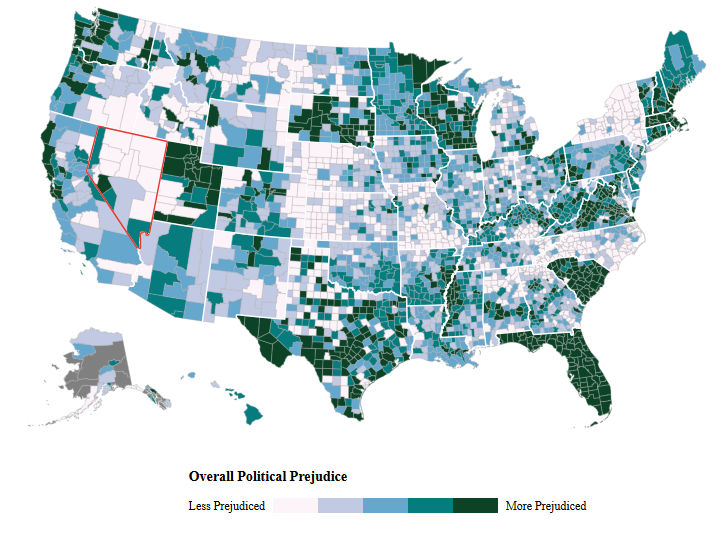
An interesting article in the Atlantic examines how polarized American voters have become - by county.  Pollsters asked residents:
how people would feel if a close family member married a Republican or a Democrat; how well they think the terms selfish, compassionate, or patriotic describe Democrats versus Republicans; and other questions designed to capture sentiments about political differences.
Here are the results:

On the interactive map in the article you can check out the results by county.  The darker colors show more political polarization with the results expressed in percentiles.  Mineral county was the most polarized (81st percentile) while Eureka County was the least (6th percentile).

In general, the pollsters found:
..the most politically intolerant Americans, according to the analysis, tend to be whiter, more highly educated, older, more urban, and more partisan themselves. This finding aligns in some ways with previous research by the University of Pennsylvania professor Diana Mutz, who has found that white, highly educated people are relatively isolated from political diversity. They don’t routinely talk with people who disagree with them; this isolation makes it easier for them to caricature their ideological opponents. (In fact, people who went to graduate school have the least amount of political disagreement in their lives, as Mutz describes in her book Hearing the Other Side.) By contrast, many nonwhite Americans routinely encounter political disagreement. They have more diverse social networks, politically speaking, and therefore tend to have more complicated views of the other side, whatever side that may be.
 It is gratifying perhaps to see so much of Nevada not being very politically polarized; unfortunately there aren't a lot of folks living in these areas. 

-- Mike Power


A Bowl of Mush